
Brand
An AI Tool Can Generate a Logo. Can It Build a Brand People Remember?
Logo generation is becoming cheap and fast. Positioning, meaning, consistency and the decisions that make an identity useful are not.
Velra Studio · · 5 min read
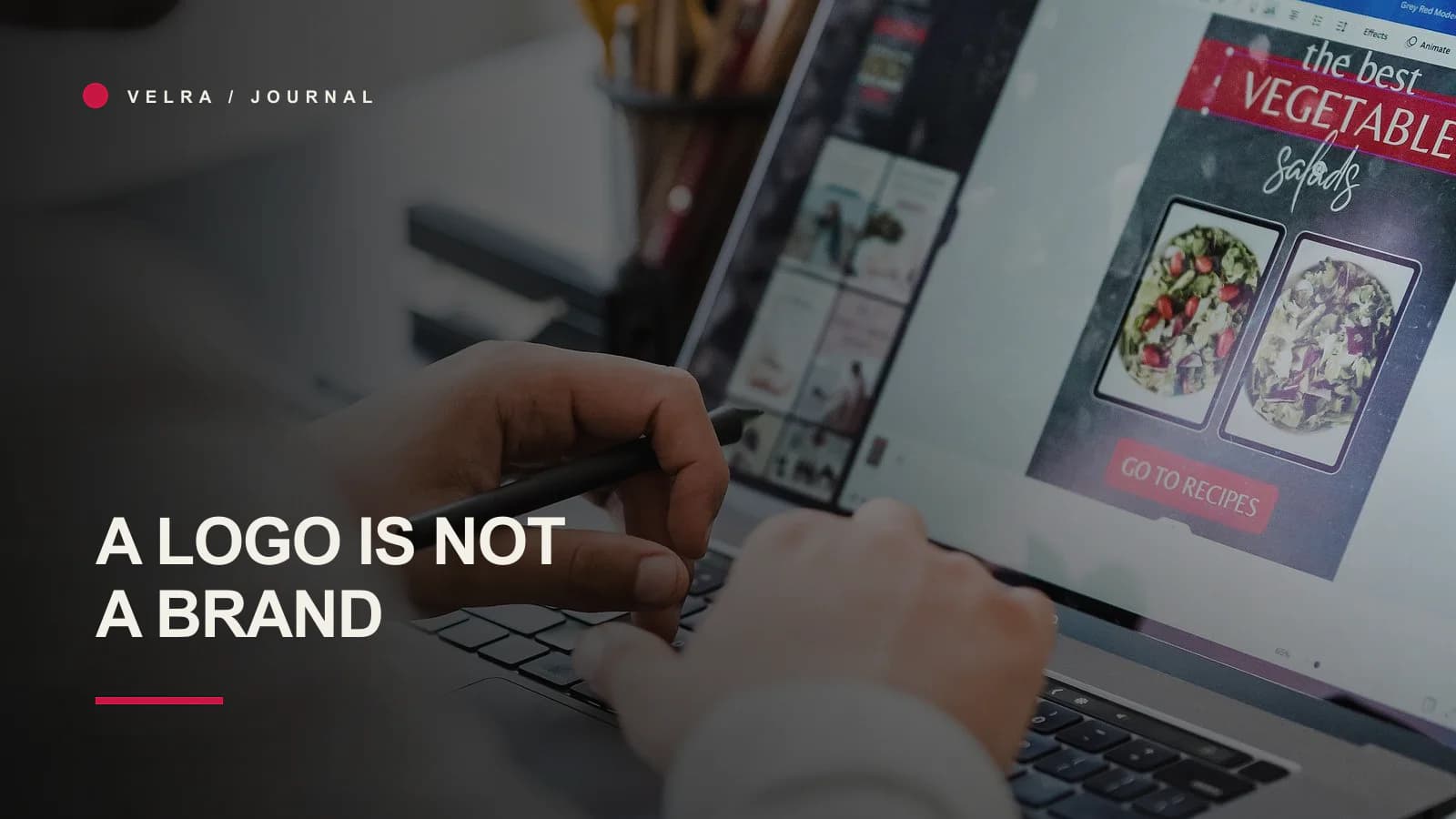
AI can generate hundreds of competent logo options before a designer has finished a first conversation. Some will be attractive. A few may even feel distinctive at first glance.
That does not make the tool a brand strategist, and it does not make every commissioned identity valuable by default.
The useful question is not whether AI can draw a logo. It plainly can. The question is whether anybody has made the decisions that allow a mark, name, voice and visual system to mean something consistent to the people the business needs to reach.
A logo is an asset; a brand is an accumulation
A logo identifies. A brand is the expectation built through what the organisation says, makes and does. Identity design gives that behaviour a recognisable form.
This distinction matters because logo generators are optimised to produce the visible artefact people ask for. They do not independently settle the positioning behind it. They do not know which parts of the organisation’s history deserve to continue, what customers currently misunderstand or how the identity must behave in a proposal, on a phone, outside a building and inside a product.
A weak brief still produces a weak answer, even when the answer is polished.
Where AI can help
We are not interested in pretending generative tools have no place in design. They can be useful for:
- broad visual exploration before a direction is chosen;
- finding references outside the first obvious category;
- testing how an idea behaves across rough applications;
- generating temporary material for prototypes;
- challenging a team to explain why one direction is more appropriate than another.
Used well, that can make the early process faster and less precious. The designer still has to curate, interrogate and rebuild. A generated image should not quietly become the final mark without checks for originality, reproducibility, ownership and resemblance to existing identities.
The UK Intellectual Property Office’s overview of intellectual property is a useful starting point for understanding the different protections that may apply. It is not a substitute for legal advice, particularly where generated material or international use is involved.
What generation cannot resolve on its own
Positioning
Before choosing a visual direction, somebody must decide what the business should be known for and what it is prepared not to claim. “Modern, premium and trustworthy” is not positioning; it is the default language of almost every weak creative brief.
Strong positioning establishes a useful tension. Is the firm established but unusually direct? Technically complex but easy to work with? Independent and specialist rather than broad and corporate? The identity can then make that decision visible.
Meaning
Symbols do not arrive with universal meaning. Meaning is built through context, repetition and behaviour. A clever explanation attached to a mark does not guarantee that customers will perceive it. We prefer an idea that can survive without a paragraph of mythology.
A working system
The mark must live with type, colour, layout, photography, illustration, motion, icons, language and interface behaviour. It must survive tiny digital spaces and large physical ones. It needs rules strong enough to build recognition and flexible enough to avoid monotony.
That is why our brand identity work is judged across applications rather than on a logo slide in isolation.
Governance
Somebody must decide which files exist, how they are named, who can use them, what happens on dark backgrounds, how partners apply the brand and when exceptions are allowed. Without governance, even a good idea fragments quickly.
Two legal identities, two different trust problems
Our work for Akande & Akande Chambers and La Peritum Law Practice did not begin with a search for “law firm logo inspiration”. That would have produced the usual scales, columns, shields and serif initials.
Both organisations needed professional credibility, but credibility was not the same design problem in each case. The work had to consider how the practice wanted to be perceived, how its services were explained and how the identity would extend into digital use. The value lay in the relationship between those decisions, not in the logo file by itself.
We are deliberately not claiming that a symbol changed commercial performance. The case studies show the system and thinking; they do not provide measured outcome data. That distinction is important.
The sameness problem
Generation models learn from existing visual culture. Asked for a mark in a familiar sector, they often converge on familiar shorthand. That can be useful for identifying what to avoid, but dangerous when speed makes the first acceptable option feel final.
Sameness is not only aesthetic. If several businesses look and sound interchangeable, customers have fewer cues for remembering or choosing one. A distinctive identity does not need to be eccentric, but it should make deliberate choices the competitors would not all make.
A better way to use AI in an identity project
We would separate exploration from decision-making:
- Define the problem without AI. Interview the people closest to the business and its customers. Establish the commercial change, audience and constraints.
- Set criteria. Agree what a successful identity must communicate and where it must work.
- Explore broadly. Use sketching, references, writing and generative tools where they contribute.
- Interrogate the options. Ask what each direction implies, resembles and excludes.
- Design the system. Build type, colour, imagery, layout and applications around the strongest idea.
- Test reality. Review at small sizes, on real content and in the hands of the people who will use it.
- Check rights and record provenance. Know where important material came from and obtain specialist advice where needed.
AI may be present in step three. It should not erase the others.
When a generated logo may be enough
For a short-lived experiment or hobby project, the cost and speed may be exactly right. Not every idea needs an identity programme. It is reasonable to spend in proportion to the consequence.
For a growing company entering a more demanding market, recruiting senior people, seeking investment or asking customers to trust a high-value service, the identity carries more weight. The brief is no longer “make us a logo”. It is “help the business become recognisable and coherent as it changes”.
That is a design problem worth treating seriously.
If your current mark is not the only issue, our guide to what a brand identity includes explains the wider system. If recognition already exists, consider whether a refresh or a complete rebrand is actually warranted before replacing it.